 Add to Chrome
 Add to Firefox
 Add to Edge
CaST-Bench: Benchmarking Causal Chain-Grounded Spatio-Temporal Reasoning for Video Question Answering
May 22, 2026
Cause-and-effect reasoning in video is a significant challenge for Vision-Language Models (VLMs), as it requires going beyond surface-level perception to a deeper understanding of causal mechanisms. However, existing benchmarks rarely provide the fine-grained, grounded evidence needed to rigorously evaluate this capability. To address this gap, we introduce CaST-Bench, a benchmark for Causal Chain-Grounded Spatio-Temporal Video Reasoning. CaST-Bench presents complex causal questions that require models to identify and localize a chain of multiple spatio-temporal evidences. Through a human-AI collaborative pipeline, we construct a high-quality dataset of 2,066 questions over 1,015 videos, with causal chains annotated by temporal segments and bounding-box tracks. Furthermore, we design a comprehensive evaluation suite with novel metrics that assess not only answer correctness but also the capability for visual evidence grounded reasoning. This grounding is crucial for improving accuracy by mitigating spurious correlations and for enhancing user trust by making models more transparent. Our experiments show that current VLMs struggle with causal questions, largely due to their limited ability to construct precise and grounded causal chains. This highlights an important direction for improving future VLMs.

Perception or Prejudice: Can MLLMs Go Beyond First Impressions of Personality?
May 21, 2026Multimodal Large Language Models (MLLMs) are increasingly deployed in human-facing roles where personality perception is critical, yet existing benchmarks evaluate this capability solely on numerical Big Five score prediction, leaving open whether models truly perceive personality through behavioral understanding or merely prejudge through superficial pattern matching. We address this gap with three contributions. (i) A new task: we formalize Grounded Personality Reasoning (GPR), which requires MLLMs to anchor each Big Five rating in observable evidence through a chain of rating, reasoning, and grounding. (ii) A new dataset: we release MM-OCEAN (1,104 videos, 5,320 MCQs), produced by a multi-agent pipeline with human verification, with timestamped behavioral observations, evidence-grounded trait analyses, and seven categories of cue-grounding MCQs. (iii) Benchmark and analysis: we design a three-tier evaluation (rating, reasoning, grounding) plus four sample-level failure-mode metrics: Prejudice Rate (PR), Confabulation Rate (CR), Integration-failure Rate (IR), and Holistic-grounding Rate (HR), and benchmark 27 MLLMs (13 closed, 14 open). The analysis uncovers a striking Prejudice Gap: across the field, 51% of correct ratings are not grounded in retrieved cues, and the Holistic-Grounding Rate spans only 0-33.5%. These findings expose a disconnect between getting the right score and reasoning for the right reason, charting a roadmap for grounded social cognition in MLLMs.
InstAP: Instance-Aware Vision-Language Pre-Train for Spatial-Temporal Understanding
Apr 09, 2026Current vision-language pre-training (VLP) paradigms excel at global scene understanding but struggle with instance-level reasoning due to global-only supervision. We introduce InstAP, an Instance-Aware Pre-training framework that jointly optimizes global vision-text alignment and fine-grained, instance-level contrastive alignment by grounding textual mentions to specific spatial-temporal regions. To support this, we present InstVL, a large-scale dataset (2 million images, 50,000 videos) with dual-granularity annotations: holistic scene captions and dense, grounded instance descriptions. On the InstVL benchmark, InstAP substantially outperforms existing VLP models on instance-level retrieval, and also surpasses a strong VLP baseline trained on the exact same data corpus, isolating the benefit of our instance-aware objective. Moreover, instance-centric pre-training improves global understanding: InstAP achieves competitive zero-shot performance on multiple video benchmarks, including MSR-VTT and DiDeMo. Qualitative visualizations further show that InstAP localizes textual mentions to the correct instances, while global-only models exhibit more diffuse, scene-level attention.
From Minutes to Days: Scaling Intracranial Speech Decoding with Supervised Pretraining
Dec 17, 2025Decoding speech from brain activity has typically relied on limited neural recordings collected during short and highly controlled experiments. Here, we introduce a framework to leverage week-long intracranial and audio recordings from patients undergoing clinical monitoring, effectively increasing the training dataset size by over two orders of magnitude. With this pretraining, our contrastive learning model substantially outperforms models trained solely on classic experimental data, with gains that scale log-linearly with dataset size. Analysis of the learned representations reveals that, while brain activity represents speech features, its global structure largely drifts across days, highlighting the need for models that explicitly account for cross-day variability. Overall, our approach opens a scalable path toward decoding and modeling brain representations in both real-life and controlled task settings.
Can MLLMs Read the Room? A Multimodal Benchmark for Verifying Truthfulness in Multi-Party Social Interactions
Oct 31, 2025As AI systems become increasingly integrated into human lives, endowing them with robust social intelligence has emerged as a critical frontier. A key aspect of this intelligence is discerning truth from deception, a ubiquitous element of human interaction that is conveyed through a complex interplay of verbal language and non-verbal visual cues. However, automatic deception detection in dynamic, multi-party conversations remains a significant challenge. The recent rise of powerful Multimodal Large Language Models (MLLMs), with their impressive abilities in visual and textual understanding, makes them natural candidates for this task. Consequently, their capabilities in this crucial domain are mostly unquantified. To address this gap, we introduce a new task, Multimodal Interactive Veracity Assessment (MIVA), and present a novel multimodal dataset derived from the social deduction game Werewolf. This dataset provides synchronized video, text, with verifiable ground-truth labels for every statement. We establish a comprehensive benchmark evaluating state-of-the-art MLLMs, revealing a significant performance gap: even powerful models like GPT-4o struggle to distinguish truth from falsehood reliably. Our analysis of failure modes indicates that these models fail to ground language in visual social cues effectively and may be overly conservative in their alignment, highlighting the urgent need for novel approaches to building more perceptive and trustworthy AI systems.
Egocentric Action-aware Inertial Localization in Point Clouds
May 20, 2025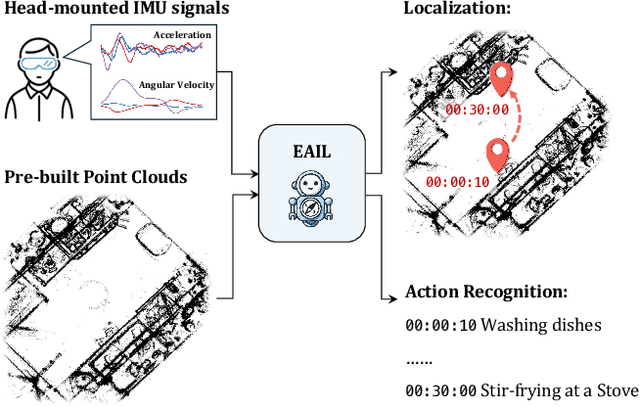
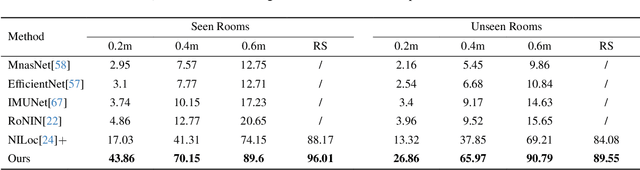
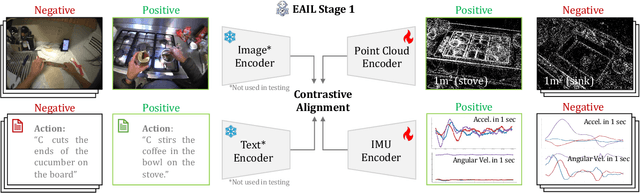
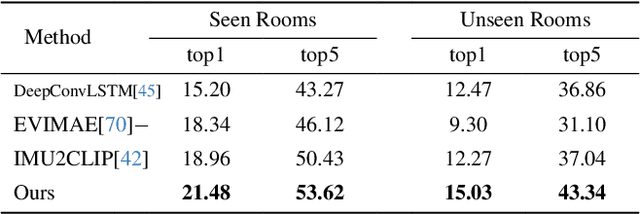
This paper presents a novel inertial localization framework named Egocentric Action-aware Inertial Localization (EAIL), which leverages egocentric action cues from head-mounted IMU signals to localize the target individual within a 3D point cloud. Human inertial localization is challenging due to IMU sensor noise that causes trajectory drift over time. The diversity of human actions further complicates IMU signal processing by introducing various motion patterns. Nevertheless, we observe that some actions observed through the head-mounted IMU correlate with spatial environmental structures (e.g., bending down to look inside an oven, washing dishes next to a sink), thereby serving as spatial anchors to compensate for the localization drift. The proposed EAIL framework learns such correlations via hierarchical multi-modal alignment. By assuming that the 3D point cloud of the environment is available, it contrastively learns modality encoders that align short-term egocentric action cues in IMU signals with local environmental features in the point cloud. These encoders are then used in reasoning the IMU data and the point cloud over time and space to perform inertial localization. Interestingly, these encoders can further be utilized to recognize the corresponding sequence of actions as a by-product. Extensive experiments demonstrate the effectiveness of the proposed framework over state-of-the-art inertial localization and inertial action recognition baselines.
An Egocentric Vision-Language Model based Portable Real-time Smart Assistant
Mar 06, 2025We present Vinci, a vision-language system designed to provide real-time, comprehensive AI assistance on portable devices. At its core, Vinci leverages EgoVideo-VL, a novel model that integrates an egocentric vision foundation model with a large language model (LLM), enabling advanced functionalities such as scene understanding, temporal grounding, video summarization, and future planning. To enhance its utility, Vinci incorporates a memory module for processing long video streams in real time while retaining contextual history, a generation module for producing visual action demonstrations, and a retrieval module that bridges egocentric and third-person perspectives to provide relevant how-to videos for skill acquisition. Unlike existing systems that often depend on specialized hardware, Vinci is hardware-agnostic, supporting deployment across a wide range of devices, including smartphones and wearable cameras. In our experiments, we first demonstrate the superior performance of EgoVideo-VL on multiple public benchmarks, showcasing its vision-language reasoning and contextual understanding capabilities. We then conduct a series of user studies to evaluate the real-world effectiveness of Vinci, highlighting its adaptability and usability in diverse scenarios. We hope Vinci can establish a new framework for portable, real-time egocentric AI systems, empowering users with contextual and actionable insights. Including the frontend, backend, and models, all codes of Vinci are available at https://github.com/OpenGVLab/vinci.
SiMHand: Mining Similar Hands for Large-Scale 3D Hand Pose Pre-training
Feb 21, 2025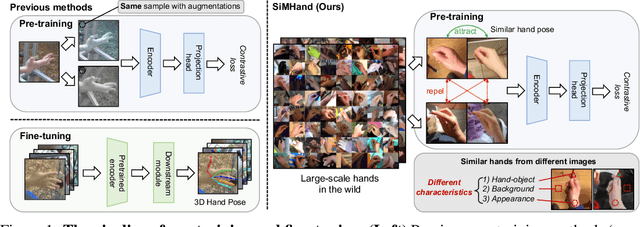


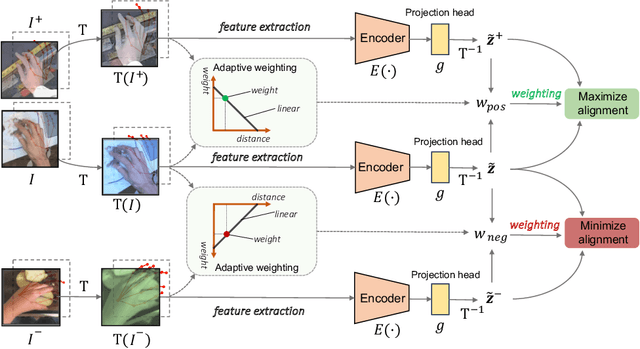
We present a framework for pre-training of 3D hand pose estimation from in-the-wild hand images sharing with similar hand characteristics, dubbed SimHand. Pre-training with large-scale images achieves promising results in various tasks, but prior methods for 3D hand pose pre-training have not fully utilized the potential of diverse hand images accessible from in-the-wild videos. To facilitate scalable pre-training, we first prepare an extensive pool of hand images from in-the-wild videos and design our pre-training method with contrastive learning. Specifically, we collect over 2.0M hand images from recent human-centric videos, such as 100DOH and Ego4D. To extract discriminative information from these images, we focus on the similarity of hands: pairs of non-identical samples with similar hand poses. We then propose a novel contrastive learning method that embeds similar hand pairs closer in the feature space. Our method not only learns from similar samples but also adaptively weights the contrastive learning loss based on inter-sample distance, leading to additional performance gains. Our experiments demonstrate that our method outperforms conventional contrastive learning approaches that produce positive pairs sorely from a single image with data augmentation. We achieve significant improvements over the state-of-the-art method (PeCLR) in various datasets, with gains of 15% on FreiHand, 10% on DexYCB, and 4% on AssemblyHands. Our code is available at https://github.com/ut-vision/SiMHand.
Brain-to-Text Decoding: A Non-invasive Approach via Typing
Feb 18, 2025Modern neuroprostheses can now restore communication in patients who have lost the ability to speak or move. However, these invasive devices entail risks inherent to neurosurgery. Here, we introduce a non-invasive method to decode the production of sentences from brain activity and demonstrate its efficacy in a cohort of 35 healthy volunteers. For this, we present Brain2Qwerty, a new deep learning architecture trained to decode sentences from either electro- (EEG) or magneto-encephalography (MEG), while participants typed briefly memorized sentences on a QWERTY keyboard. With MEG, Brain2Qwerty reaches, on average, a character-error-rate (CER) of 32% and substantially outperforms EEG (CER: 67%). For the best participants, the model achieves a CER of 19%, and can perfectly decode a variety of sentences outside of the training set. While error analyses suggest that decoding depends on motor processes, the analysis of typographical errors suggests that it also involves higher-level cognitive factors. Overall, these results narrow the gap between invasive and non-invasive methods and thus open the path for developing safe brain-computer interfaces for non-communicating patients.
Pre-Training for 3D Hand Pose Estimation with Contrastive Learning on Large-Scale Hand Images in the Wild
Sep 15, 2024


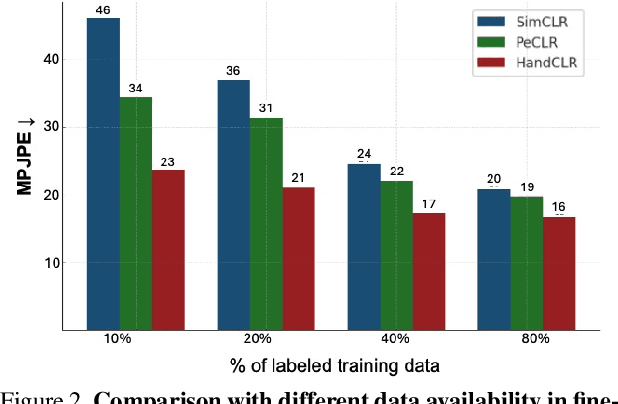
We present a contrastive learning framework based on in-the-wild hand images tailored for pre-training 3D hand pose estimators, dubbed HandCLR. Pre-training on large-scale images achieves promising results in various tasks, but prior 3D hand pose pre-training methods have not fully utilized the potential of diverse hand images accessible from in-the-wild videos. To facilitate scalable pre-training, we first prepare an extensive pool of hand images from in-the-wild videos and design our method with contrastive learning. Specifically, we collected over 2.0M hand images from recent human-centric videos, such as 100DOH and Ego4D. To extract discriminative information from these images, we focus on the similarity of hands; pairs of similar hand poses originating from different samples, and propose a novel contrastive learning method that embeds similar hand pairs closer in the latent space. Our experiments demonstrate that our method outperforms conventional contrastive learning approaches that produce positive pairs sorely from a single image with data augmentation. We achieve significant improvements over the state-of-the-art method in various datasets, with gains of 15% on FreiHand, 10% on DexYCB, and 4% on AssemblyHands.